
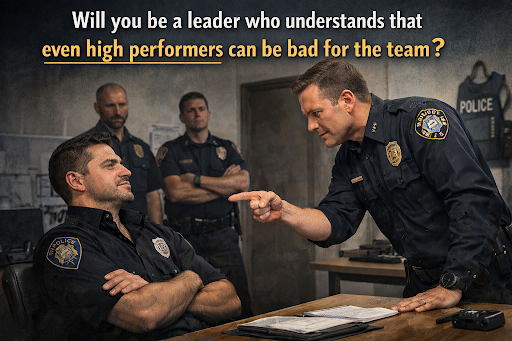
Will you be a leader who understands that even high performers can be bad for the team?
Inheriting an employee who has been allowed to behave poorly is a challenge most leaders face. It is unfortunate that the previous leader didn’t do their job. But now it is left up to you. Leading a problem employee becomes your defining moment. You have a choice: maintain the status quo or rock the boat. What you choose in these situations is a window into your character. It will also set the tone for the rest of your time in leadership with that particular team.
At one point, I took over a team with a highly skilled individual who also had character issues. He was good at the tactics of the job. But he also cut corners, missed administrative deadlines, and created division within the team. The previous leader did nothing about these behaviors because his sales performance was consistently one of the best within the team.
But, when I took over the team, I quickly realized this guy was a huge problem. If he did not change his behaviors, the team would never reach its potential. It turned out to be a test of my character. Just like it is a test of any leader’s character when they inherit a person the previous leader refused to correct.
The character tests include:
Courage: Acting despite perceived or actual risk.
Are you willing to take the time to coach, document the behavior, and follow through on what needs to be done to change this person’s behavior? Initially, this person will probably push back and not make it easy for you. They will point to former leaders who said nothing and maybe even gave them high scores on previous performance evaluations. What will you do?
Humility: Believing and acting like “it’s not about me.”
This will be a process that will take time and energy upfront. It will probably include uncomfortable conversations. It could also mean the team loses a highly skilled contributor thus creating an initial drop in team performance – making you look bad. But, our comfort or how our performance looks to others is not the goal. This is not about what is easy or best for the leader. This is about what is best for the team. The team needs this behavior to change. We must put the needs of the team ahead of ourselves.
Integrity: Doing what is good, right and proper, even at personal cost.
The team is waiting to see what you will do about someone who is obviously not making good choices. Will you uphold the standards with the problem person like you do with others? Or will his measurable performance cause you to overlook his character issues. Will you be the leader who understands that even high performers can be bad for the team? WIll you act on the standards you claim are important?
Duty: Taking actions based on our assigned tasks and our moral obligations.
It is your moral obligation to correct the behaviors. If the person won’t make the correction, then your moral obligation continues to disciplinary action and even to the end of their employment. That means you must document the poor behaviors, the lack of change after coaching, and the continued negative impact upon the team. Do the paperwork. Start it as soon as you have witnessed the pattern of behavior and the lack of change on their part.
For many supervisors, the challenges faced are not truly about the other person or the paperwork involved. The real challenge is inside the supervisor. Are you willing to address the issue? Once a leader shows the commitment to do the right thing in these situations, the stage is set for that leader to have the impact they should have. The leader who steps forward and addresses the issue with the high performing yet problematic employee, will build respect with the rest of the team, and alter that team’s course in the future. That team will go beyond just being a compliant group and will become a committed team.
That is what happened in my case. My hard headed employee paid lip service to changing and then began to slide backwards. His true character came out and he ended up making a series of decisions that I documented. Those decisions made it easy for us to ask him to leave. When he was gone, there was a sigh of relief from the team and from me! The team changed instantly when he left and we got better as a result.
The next scenario we will cover is – How Does a Supervisor Deal with Unpopular Policies.
Hint: It is another character test for all leaders!
Question:
What happens when a problem employee continues to negatively impact the team?
Who’s responsible for dealing with that situation?