
No matter what the values on your challenge coin say, you can bet they don’t align with this guy’s behaviors.
Every leader runs into this guy. I did in the Army and in sales. You will whether you are leading in the fire services, law enforcement, or even in an engineering firm. I’m talking about the highly competent yet cancerous employee. He’s the guy you want by your side when you go through that door and are unsure what is on the other side. Operationally, he’s a stud. He’d win a head to head competition with his peers in most training situations. When you are on a call, and things get tough, he elevates his game and comes through. Having these guys in the fire services or law enforcement usually make people safer.
The problem is, those operational moments, while critical, are a small sliver of time compared to the time he spends waiting for those critical incidents. As he waits, he destroys. Maybe he’s arrogant, disrespectful, crude, angry, lazy with paperwork, or all of the above.
His lack of character has just become your character test.
Can or Can’t You Live Without Him On Your Team?
Being good at your job means you’re more than one dimensional. You have to be good operationally and also be an asset when things are slow. Yet in the back of your mind you wonder if your team can live without him? The answer is “Yes!” You can live without him. And your team will thank you for changing his behavior or changing his place of employment.
When you decide to finally address this issue, you will be passing a character test. It is probably a test that other leaders have failed. But, you will be the first and perhaps you will be the supervisor that turns this guy into a model cop or firefighter.
Passing this character test means you will need to exercise Courage, Integrity, Duty, and Positivity. This person is testing you and your leadership. Will you pass the test?
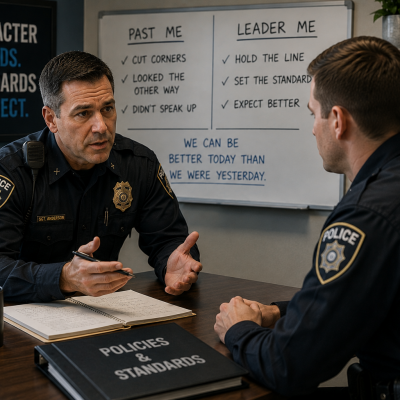
What Does the Conversation Sound Like?
Dave, operationally, you’re a stud. Unfortunately, that is only one dimension to this job. You have a lot more in you than what you have been showing. When you are disrespectful to leadership, argue with feedback, tear down your peers, or late with paperwork, you show yourself to be one dimensional.
You need to be more than that. You need to be someone people can count on, believe in, and trust both on the scene and back in the house. A one dimensional person becomes less and less valuable to the team as time goes on. I want to see you reach your potential and be the person you’re capable of being on this job. What do you want?
Courage: Acting despite perceived or actual risk.
This will not be a comfortable conversation. That is why you will need to exercise Courage. You will need to be direct and not sugarcoat his negative impact on the team. You will need to set clear expectations for his behaviors and then stick to your guns.
Integrity: Doing what is good, right, and proper even at personal cost.
No matter what the values on your challenge coin say, you can bet they don’t align with this guy’s behaviors. If you say you have values, yet you don’t correct behaviors that are outside those values, that is a form of hypocrisy.
Duty: Taking action based on your assigned tasks and moral obligations.
While it is your moral obligation to address this issue, it is also your moral obligation to give him clear expectations and coach him toward his potential. If he refuses to be the teammate he needs to be in his job, then it becomes your moral obligation to begin the discipline process since he is refusing to adapt.
Positivity: Displaying a positive and/or “can do” attitude in all circumstances.
Morale is an inside job. Guys like this create divisions within the team. Some will think he’s cool and align with him. Others will stay silent and hope a leader will step up and change something. It is your job as the leader to protect the morale of the team and ensure he does not lead the team down the wrong path.
Now It is Up To You To Say Something and For Him to Do Something
If he turns his behaviors around, now you have an invaluable asset. While maintaining his operational excellence, he now becomes the go to guy in all situations. He becomes a model cop or firefighter. He becomes your agency’s next promotion candidate. But, that is up to you as his supervisor.
Because he is great operationally, he will wield a lot of influence on your team. Will it be positive or will it be negative? If you allow it to be negative, who is really the leader of the team?
Question:
- What could happen if you continue to ignore this situation?
- What could happen if you finally address it?