
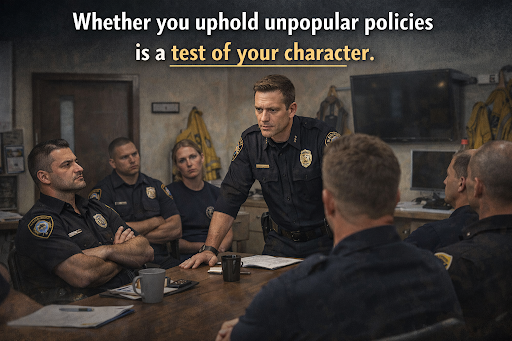
Whether you uphold unpopular policies is a test of your character.
Here’s the truth about life in the middle of any organization. There will always be policies that people don’t like. You may not agree with the policies either. I get to work with supervisors in the fire services, law enforcement, and in businesses all the time. Every single leader in those organizations faces unpopular policies. Knowing how to handle unpopular policies as a leader – is not a question of your management skills. It is a challenge of your character.
Some leaders will just tell the team, “It’s policy, so do it.” Others will say, “I don’t agree with this, but they made the decisions so….” And some say, nothing and ignore the chatter coming from their team or just ignore the policy and not follow through on it. This is the same pattern seen in problem employee leadership, where leaders avoid enforcing standards when it becomes uncomfortable.
How to Handle Unpopular Policies as a Leader
When you choose any of these routes, you fail a character test and you fail in how to handle unpopular policies as a leader. It could be one Habit of Character or multiple Habits of Character that are failing.
Courage: Acting despite perceived or actual risk.
You need to exercise the Courage to uphold all the policies, even the unpopular ones.
Humility: Believing and acting like “it’s not about me.”
You need Humility to recognize that you may not have the “Why” behind the policy, and therefore your judgement could be wrong.
Integrity: Doing what is good, right and proper, even at personal cost.
You need Integrity to realize you can’t pick and choose which policies to enforce and which ones to ignore.
Selflessness: Putting the needs of others before my own needs, desires or convenience.
Your role as a leader is not to get your way, but to put the team or organization’s needs before your own desires.
Duty: Taking actions based on our assigned tasks and our moral obligations.
If the policy is not asking you to do anything immoral, illegal, or unethical, then your moral obligation is to support that policy.
Positivity: Displaying a positive and/or “Can do” attitude in all circumstances.
Let your people vent and then turn the conversation to how to be the best at implementing the policy.
A police department, fire department, or business will never get beyond mediocrity if each member is allowed to cherry pick the policies they follow. When a leader does this, or allows others to do it, the only thing that will be consistent is chaos. And that is the side effect of that leader’s character.
If the “Why” behind the policy has not been communicated from your leaders above, then it is a supervisor’s moral obligation to ask for the Why and then share it with the team. Sometimes people will still not like the policy. But that does not absolve them of the Duty to follow that policy, or you of the Duty to uphold that policy.
When you understand how to handle unpopular policies as a leader, you create consistency, trust, and clarity within their teams. It becomes clear to everyone what exercising Integrity in the organization looks like. And the leader is exercising the character people respect and want to follow.
This was supervisor scenario four in our six part series. We present these scenarios as an illustration of how every leader’s character is tested in the day to day life of a supervisor. We want you to pass those tests!
Question:
- Are you consistent with your approach to following policies?
- Do you have the Courage to change that if your answer was “no”?
The next in the series is related to this one: When Bureaucracy Makes it Hard to Fire People.